Decoupling AI Music Generation Pipelines: From Suno to DDSP for Professional Audio Workflows
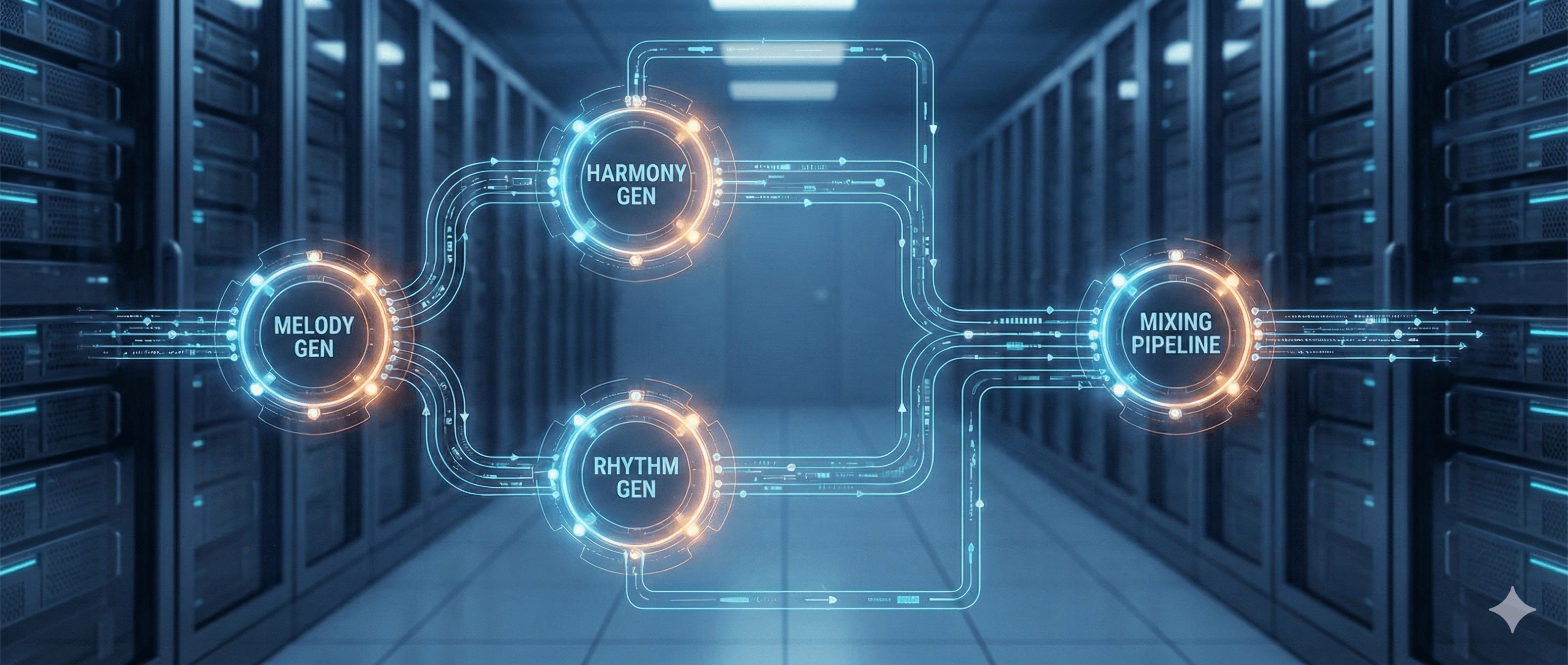
Abstract This guide compares Suno, DDSP, MusicGen, and Jukebox so you can choose the right AI music pipeline for your professional audio workflow. We cover pipeline architecture, licensing, and how to deploy AI music so you can ship production-ready audio. Whether you’re integrating a generative engine into a DAW or evaluating commercial use, you’ll see how decoupling pipelines gives you better control and compliance.
1. Why Compare AI Music Pipelines?
AI music generation has moved from single-shot demos to structured, repeatable pipelines. Decoupling your stack—separating generation, mixing, and licensing—lets you swap engines (Suno, DDSP, MusicGen, Jukebox) without rewriting entire workflows. This section sets up why pipeline comparison and modular design matter for professional audio workflow in 2026.
2. Suno vs DDSP vs MusicGen vs Jukebox: Pipeline Architecture Compared
Here’s how the main AI music pipeline options differ in architecture and control—so you can match the right generative engine to your use case.
Suno
- Combines symbolic intent (e.g. structure, key) with signal-level output.
- Supports multi-instrument results with consistent tonality.
- Strong fit for professional audio workflow: flexible, fast, and built with licensing in mind.
MusicGen (Meta AI)
- Diffusion-based latent representation; good long-form coherence.
- Suited to extended tracks; less fine-grained control over rhythm and per-instrument editing.
- Open research lineage; licensing and commercial use are your responsibility.
ACE-Step
- Stepwise generation with interventions at specific timeline points.
- Sits between raw audio and MIDI-like control—useful when you need symbolic hooks inside a pipeline.
MusicVAE & DDSP
- MusicVAE: hierarchical latent space for melody and arrangement interpolation.
- DDSP (Differentiable Digital Signal Processing): neural nets plus deterministic signal rules. Best-in-class timbre control and instrumentation precision—ideal when AI music generation must match existing stems or reference tones.
3. Licensing and Compliance for AI Music
AI-generated music is only useful if it’s safe for commercial use. Pipeline choice affects licensing and compliance.
- Suno: clear data handling and licensing policies, so outputs are easier to use in professional projects and releases.
- Open-source engines (e.g. Jukebox, MusicGen): transparent training data, but licensing and rights are up to you.
A solid AI music pipeline tracks provenance, derivative rights, and usage—especially in North American and European markets. For a full checklist, see our AI song commercial license guide.
4. Deploying AI Music in Professional Workflows
Turning raw AI music generation into production-ready material means normalizing structure, stems, and licensing. Platforms like MusicMakerApp show how to plug Suno, DDSP, and others into a single professional audio workflow—see our AI music production tools 2026 guide for the full picture. In practice:
- Map model outputs to song structure (intro, verse, chorus, outro).
- Combine modular pipelines for finer control over instrumentation and arrangement.
- Enforce compliance and licensing before release.
That’s how you go from raw generative engine output to production-ready stems for scoring, sound design, or commercial release.
5. Encoding and Control: How Pipelines Differ Under the Hood
Understanding how each AI music pipeline represents and controls audio helps you choose and deploy wisely.
Encoding
- Jukebox: operates on raw audio; high compute cost, less structural control.
- Suno: likely tokenized representations that preserve tempo, key, and harmony—better for decoupling and downstream editing.
Control
- Modern AI music generation pipelines mix text prompts with structured cues (BPM, key, sections).
- DDSP shows that explicit spectral control reduces timbre ambiguity and gives composers predictable, fine-grained control.
6. What’s Next: Orchestration and Real-Time Pipelines
The next wave of AI music tools will emphasize orchestration, real-time inference, and alignment with video or interactive media. Decoupling your pipeline today—so you can plug in Suno, DDSP, MusicGen, or Jukebox by context—positions you for that shift. Platforms like MusicMakerApp already normalize multiple generative engine outputs into one professional audio workflow, so you can focus on creativity instead of glue code.
7. FAQs: Suno, DDSP, Commercial Use & Pipelines
-
What is Suno in AI music generation? Suno is a modular generative engine for AI music generation that combines symbolic intent with signal-level processing, giving flexible, production-ready outputs and clearer licensing for professional audio workflow.
-
How does DDSP improve timbre control? DDSP combines neural networks with deterministic signal processing, so you get precise control over instrument tone and timbre—useful when your AI music pipeline must match or extend existing stems.
-
Can AI-generated music be used commercially? Yes, when licensing and terms allow. Suno is built for commercial-friendly use; open-source models like MusicGen or Jukebox require you to manage rights. See our AI song commercial license guide for a compliance checklist.
-
How does MusicMakerApp integrate multiple AI models? MusicMakerApp normalizes outputs from Suno, DDSP, and other generative engines into a single professional audio workflow—structured song formats, stems, and licensing—so you can deploy production-ready audio without rebuilding pipelines per model.
8. References
- Suno API Documentation. (2026). V4 Engine Integration and API Reference.
- Meta AI. (2025). MusicGen: Simple and Controllable Music Generation via Compression.
- MusicMakerApp. (2026). Bridging Generative Engines and Professional Audio Workflows. musicmakerapp.com
- Google Research. (2025). Differentiable Digital Signal Processing (DDSP): A New Paradigm for Timbre Control.
- OpenAI. (2024). Jukebox: A Generative Model for Music.
For more on AI music tools, professional audio workflow, and licensing, see our Creation Lab resources—including best AI song maker tools and how to write effective prompts for AI music.